Meditation basics
What Is Secular Meditation? A Clear Guide for Beginners
Understand what secular framing means, how to respect meditation’s roots, and what to look for in a guide that fits your preferences and beliefs.
By My Inner Day · · Updated · 6 min read

What is secular meditation?
Secular meditation is taught without requiring participation in a religion or acceptance of a particular spiritual belief. Instructions usually describe an activity you can try: noticing a sensation, attending to a sound, or returning attention when it wanders. The word secular describes the framing of the practice, not a guarantee about its effects.
This distinction can help you choose a guide. You may want a practical attention exercise while keeping your personal beliefs private. Someone else may want meditation embedded in religious study or community. Neither preference needs to be treated as a problem; the important question is whether the programme clearly explains what it offers.
Secular does not mean without history
Modern wellbeing practices did not appear from nowhere. Many forms of meditation have developed within religious and philosophical traditions, and contemporary teachers draw on different sources. A secular presentation can acknowledge those roots while using instructions that do not ask participants to adopt the beliefs of a tradition.
Avoid assuming that every practice called meditation has the same aim. A short attention exercise, devotional practice, and a structured clinical programme may differ in purpose, teaching, and context. Similar-looking postures do not make them interchangeable. Respecting those differences is more useful than claiming one format is the original or universally correct version.
What a session can involve
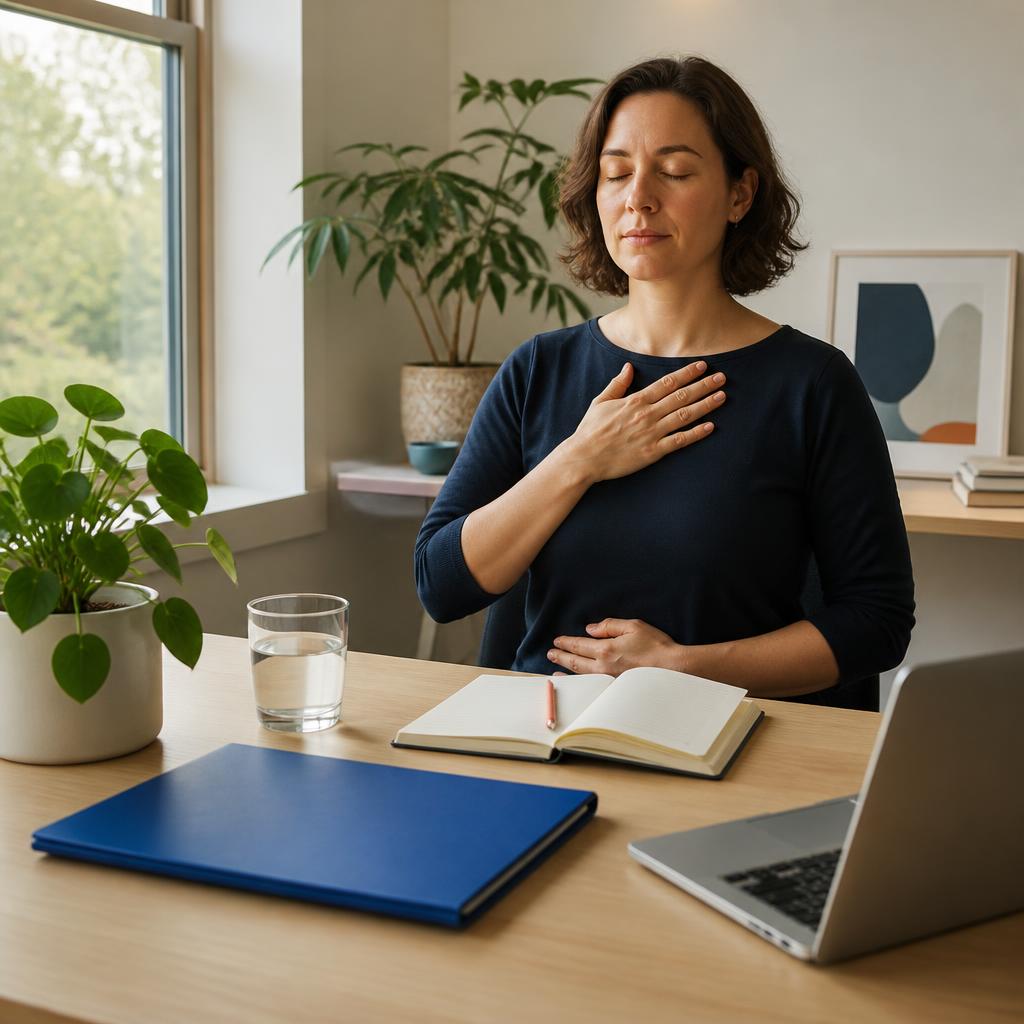
A simple secular session may begin with a supported position and an ordinary anchor for attention. You might notice your hands resting, sounds in the room, or natural breathing. When you realise attention has moved elsewhere, return to the anchor. You can keep your eyes open and adjust your position when necessary.
The instructions should explain what to do without asking you to believe that a particular sensation proves spiritual progress. You can finish a session feeling settled, distracted, or much as before. The activity is still understandable: you tried a brief exercise and can decide whether its format suits you.
Meditation, mindfulness, and relaxation
These terms often appear together, but it helps to ask what the guide means by each. Meditation is a broad label for different practices. Mindfulness can refer to a way of attending to present experience. Relaxation describes an experience or an intended aim of some exercises; it is not a compulsory result of every session.
For a beginner, a concrete description is more useful than a sophisticated label. “Notice the chair, listen to the room, and return when distracted” tells you what to do. “Reach a higher state” leaves much more interpretation. Choose instructions you can understand and question, especially when exploring a new format.
Where MBSR fits
UMass Memorial Health dates the development of Mindfulness-Based Stress Reduction to 1979, when Jon Kabat-Zinn established its Stress Reduction Clinic. MBSR is a named programme with its own structure. Its history is part of the modern use of mindfulness in healthcare, rather than the beginning of meditation as a whole.
A general meditation app is not automatically an MBSR course. Sharing some language or exercises does not establish that it provides the same teaching, support, or outcomes. When a programme uses a clinical label, check what is actually included and who provides it. My Inner Day offers a guided wellbeing journey, not a claim to deliver that clinical programme.
Can religious people use a secular guide?
A person can choose a secular exercise without being asked to discuss or change their beliefs. Whether a particular practice fits someone's faith or values is a personal decision. Read the description and, where relevant, discuss concerns with a trusted person in your own tradition rather than relying on a generic assurance from an app.
The same choice applies to people who are non-religious, uncertain, or uninterested in labels. A clear guide should let you understand the exercise and decline parts that do not suit you. You do not need to disclose a worldview in order to ask for practical instructions or a different attention anchor.
How to choose a suitable programme
Look for plain descriptions of the sessions, their length, and what participation involves. Check whether the guide uses religious language, visualisation, affirmations, silence, or body-focused attention. These are different features, and preferences vary. A preview or written example can help you assess the style before committing to a routine.
Consider the claims as well as the voice and design. A secular label does not make every health promise well supported. Look for clear sources, realistic expectations, and permission to stop or adjust. You should be able to ask what a programme offers without being told that doubt itself is the reason it may not work.
Try an ordinary two-minute exercise
Sit with comfortable support and look around the room. Choose a neutral object or notice where your feet meet the floor. Rest attention there for a few moments. When you realise you are following a thought, return to the chosen object or contact. Leave your breathing natural and move if you need to.
After the short interval, notice the room again and continue with your day. You do not need to interpret the experience or give it a spiritual meaning. Ask whether the instructions were clear and whether the exercise felt suitable. If it was distressing, stop and choose another activity or appropriate support.
Respect choice in shared settings
In a workplace or group, explain the activity before asking people to join. Allow eyes-open participation, comfortable positions, and an easy option to decline. Avoid requiring people to report private thoughts or emotions afterwards. The absence of religious language does not remove the need for consent and individual choice.
Also avoid presenting a brief group exercise as a solution to structural problems. A calm-looking room does not prove that workload, safety, or personal concerns have been addressed. Meditation can be an optional activity alongside practical support, not a condition people must meet before their concerns are taken seriously.
Common questions
Is secular meditation anti-religious?
The term means that the activity does not require a religious commitment. It does not by itself express opposition to religion. Check the actual programme rather than assuming every use of the label means the same thing.
Is it automatically evidence-based?
No. Evidence concerns a specific intervention and outcome, not simply the word secular. Ask which claims are supported and whether the cited programme resembles what is being offered.
Do I have to use breathing as an anchor?
No. A simple exercise can use contact with the floor, ordinary sounds, or a comfortable visual point. Choose a clear, manageable format and keep the option to adjust it.
Sources and further reading
These articles offer general educational information. Exercises and sample schedules are editorial suggestions, not clinical protocols. The linked resources provide background and do not endorse My Inner Day.